Tag: Booking

  • How to Add an Event Calendar to Your WordPress Site

    How to Add an Event Calendar to Your WordPress Site

    Your WordPress site can list pages and posts just fine, but when it comes to showing events on a calendar, with dates, times, and the ability to book, you need something more. A visual event calendar lets visitors browse what’s coming up, see availability at a glance, and take action without leaving your site.

    This guide shows you how to add an interactive event calendar to any WordPress page in a few minutes, using a free plugin. No coding, no theme changes.

    What You’ll End Up With

    An interactive calendar on your site that:

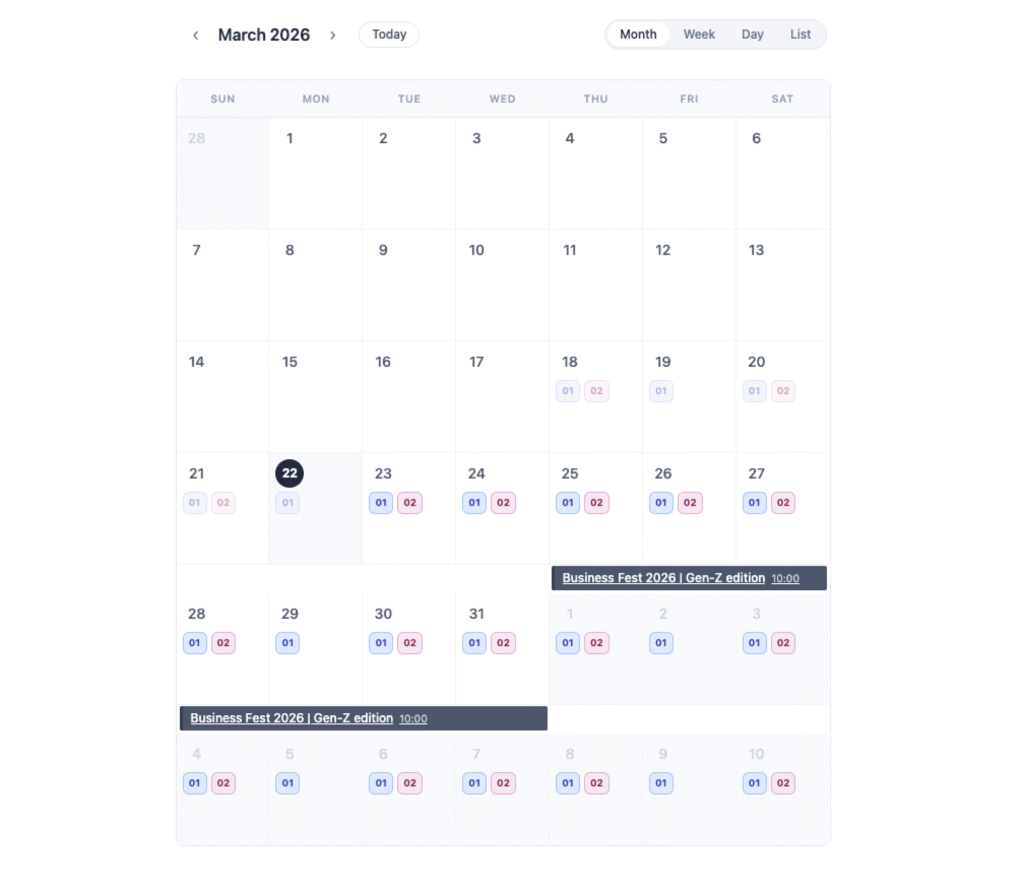
    • Shows events in month, week, day, or list views
    • Lets visitors switch between views
    • Displays multi-day events spanning across calendar cells
    • Links each event to its own page for details and booking
    • Works on mobile and desktop
    • Updates automatically when you add or edit events
    Step 1: Install Nemtly Booking

    If you haven’t already:

    1. Go to Plugins → Add New in your WordPress admin
    2. Search for “Nemtly Booking”
    3. Click Install Now, then Activate

    The plugin handles both event management and calendar display, so you don’t need separate plugins for each.

    Step 2: Create a Few Events

    A calendar isn’t much to look at without events on it. If you already have events, skip ahead to Step 3.

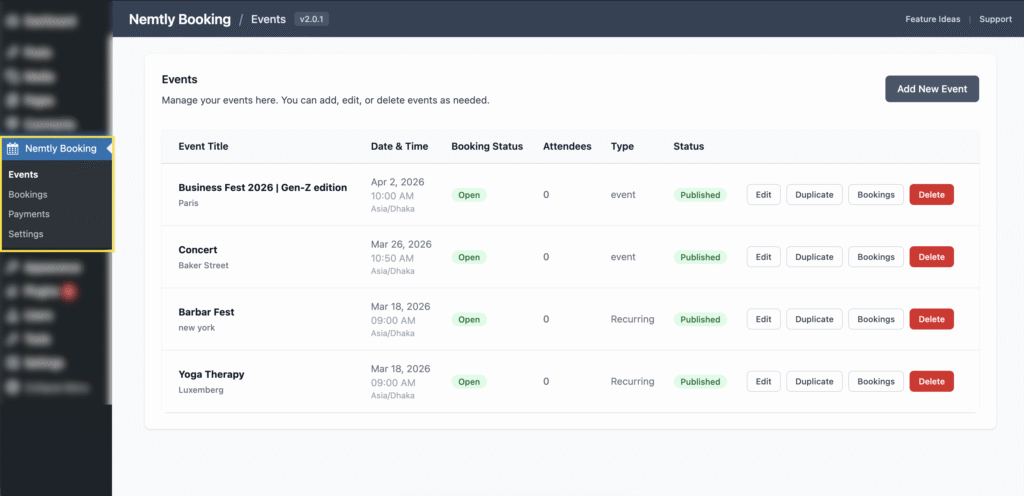
    Go to Nemtly Booking → Events and click Add New Event. You’ll need at minimum:

    • A title (e.g., “Team Strategy Workshop”)
    • A date and time — set in the Schedule step of the event form
    • Click Publish

    Create 2–3 events across different dates so your calendar has something to display. You can always edit or add more later.

    For a detailed walkthrough of event creation, see this guide: How to Create a Booking System on WordPress.

    Step 3: Add the Calendar to a Page

    You have two options depending on how you build pages.

    Option A: Gutenberg Block (Block Editor)

    1. Open any page in the WordPress block editor (or create a new one, e.g., “Events Calendar”)
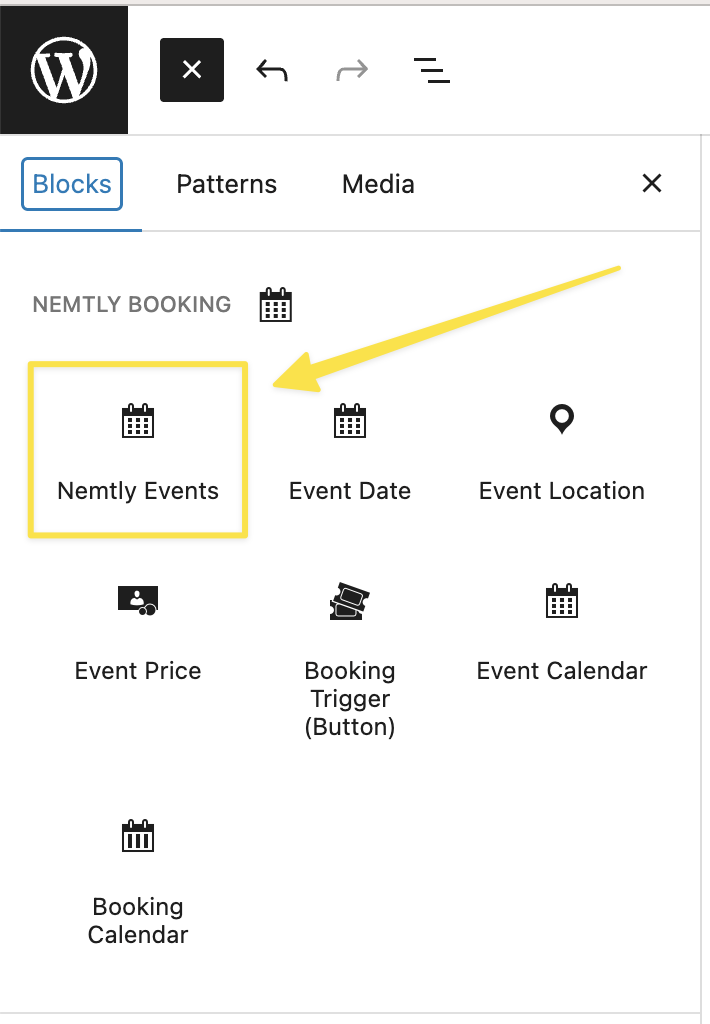
    2. Click the + inserter button and search for “Event Calendar”
    3. Insert the block

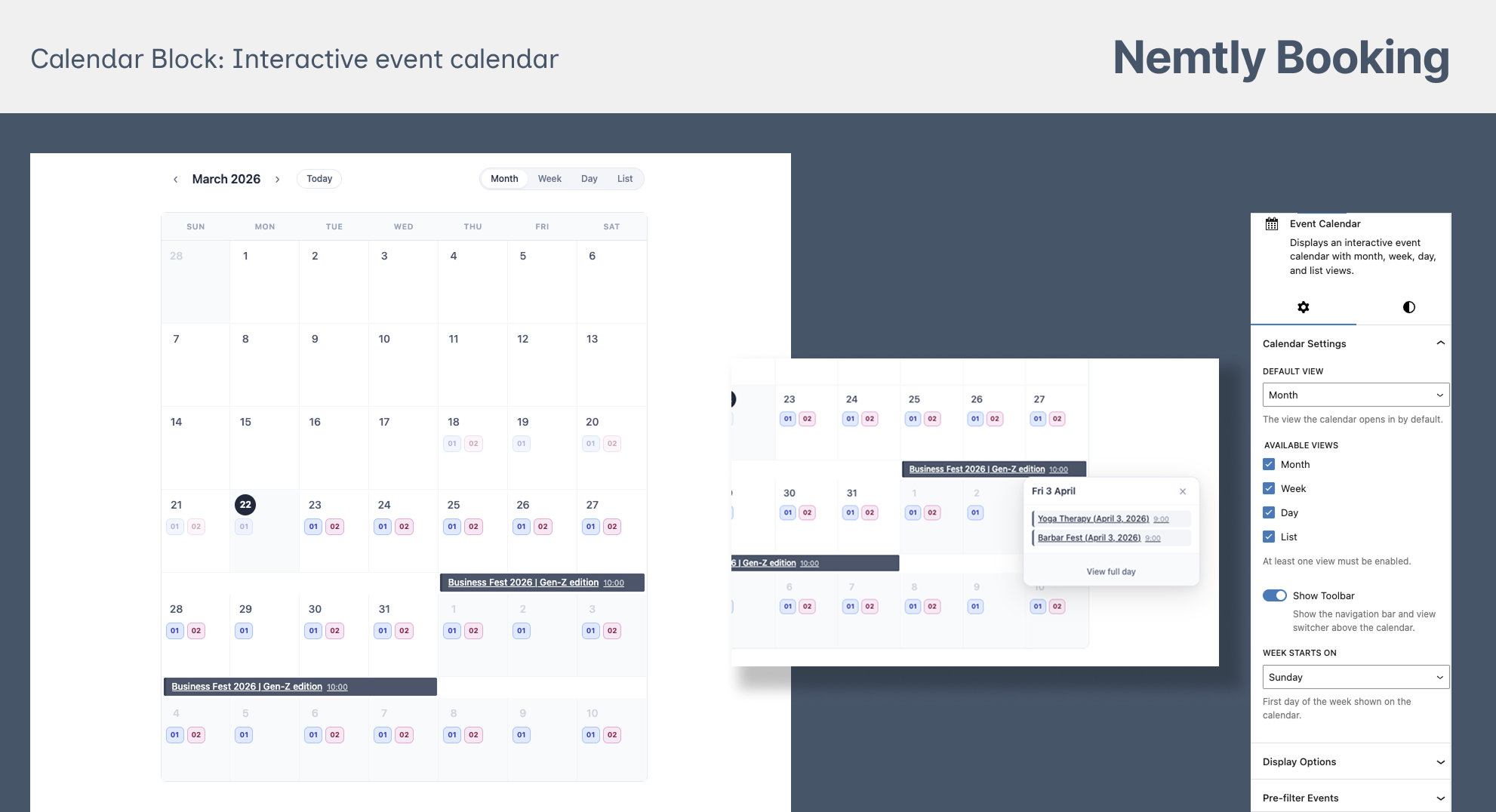
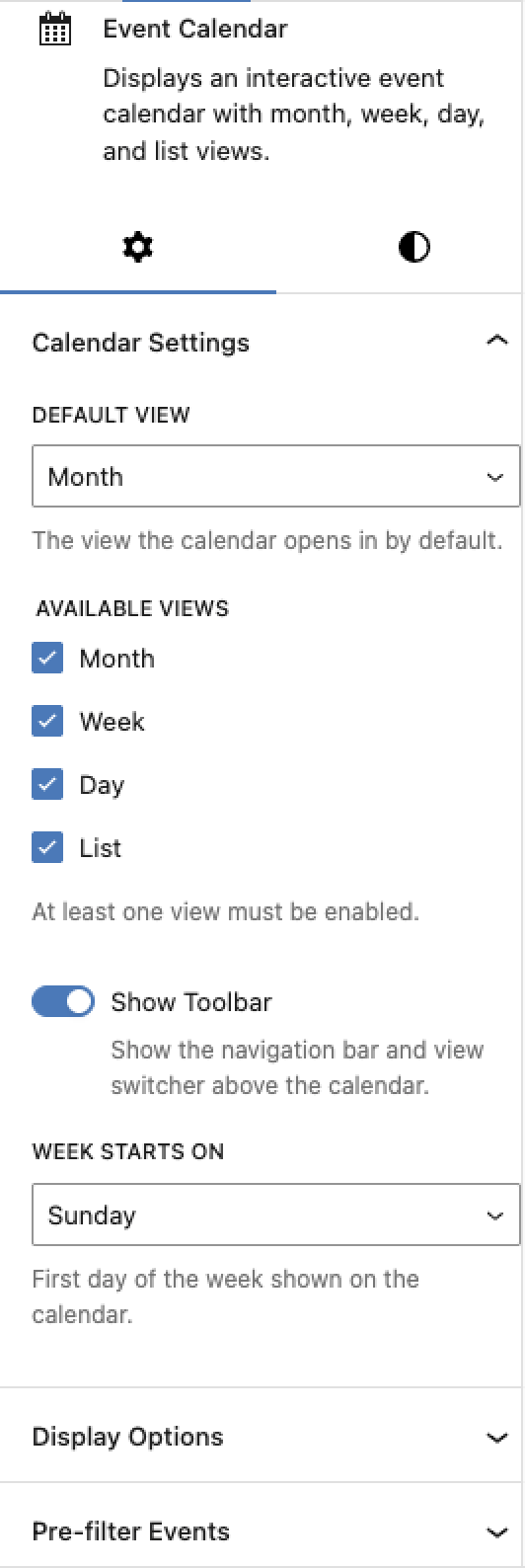
    The calendar appears immediately in the editor with a live preview. You can configure it using the block sidebar panel:

    • Default view — Which view loads first: month, week, day, or list
    • Available views — Which views visitors can switch between using the toolbar
    • Show toolbar — Toggle the navigation bar with month/week navigation arrows
    • Show filters — Toggle filter dropdowns above the calendar
    • First day of week — Sunday or Monday
    • Events per cell — Maximum events shown per day before a “+N more” link appears (default: 3)
    • Time format — 12-hour, 24-hour, or match your WordPress site setting
    • Show event time — Display start times on event chips
    • Show “Book Now” button — Whether event popups include a booking link
    • Show past events — Include or hide events that have already happened
    • Height — Auto (grows with content) or fixed pixel height
    Publish the page and your calendar is live.

    Option B: Shortcode (Classic Editor or Page Builders)

    Paste this shortcode into any page, post, or widget area:

    [nemtly_calendar]

    That’s it for the defaults. The calendar renders with month view, all four views available, toolbar and filters visible.

    To customize, add attributes:

    [nemtly_calendar view="week" show_filters="false" week_starts_on="monday"]

    Available shortcode attributes:

    AttributeOptionsDefault
    viewmonth, week, day, listmonth
    viewsComma-separated list of allowed viewsmonth,week,day,list
    show_toolbartrue, falsetrue
    show_filterstrue, falsetrue
    week_starts_onsunday, mondaysunday
    events_per_cellAny number3
    time_format12h, 24h, site_defaultsite_default
    show_event_timetrue, falsetrue
    show_booking_btntrue, falsetrue
    show_past_eventstrue, falsefalse
    heightauto, fixedauto
    height_pxAny number (pixels)600

    The shortcode works inside Elementor, Beaver Builder, Divi, and any other page builder that supports WordPress shortcodes.

    Understanding the Calendar Views

    Each view serves a different purpose. Choosing the right default depends on your use case.

    Month View

    The classic calendar grid. Best for:

    • Event organizers showing a full month of activities
    • Businesses with events spread across many dates
    • Visitors who want a big-picture overview

    Events appear as chips on their date. Multi-day events span across cells. If a day has more events than the events_per_cell limit, a “+N more” link appears.

    Week View

    A 7-day view with time slots visible. Best for:

    • Service providers showing a week of available appointments
    • Fitness studios displaying a weekly class schedule
    • Visitors who need to see exact times

    Day View

    A single day with hour-by-hour detail. Best for:

    • Busy days with many events (conferences, all-day workshops)
    • Showing a detailed schedule for a specific date

    List View

    A chronological list of upcoming events — no grid, just a clean list. Best for:

    • Simple event listings without the visual calendar overhead
    • Mobile-first sites where a grid may feel cramped
    • Visitors who just want to scan what’s coming up

    Clicking an Event

    When a visitor clicks an event on the calendar, they’re taken to the event’s dedicated WordPress page. There they can see the full description, date and time details, location, pricing, and the booking form.

    This means your calendar serves as both a visual overview and a navigation tool — visitors find what interests them, click through, and book.

    Common Setups

    Here are a few real-world examples of how to configure the calendar for different use cases.

    Yoga Studio Weekly Schedule

    Show a repeating weekly schedule where students pick a class time:

    [nemtly_calendar view="week" show_past_events="false" week_starts_on="monday" time_format="12h"]

    Or use the block and set Default view to “week” and First day of week to “Monday” in the sidebar.

    Conference or Meetup

    Show a single month with event days highlighted:

    [nemtly_calendar view="month" views="month,list" show_booking_btn="true"]

    Limiting available views to month and list keeps it simple — no one needs week/day view for a monthly conference calendar.

    Consultant Availability

    Show a day-by-day breakdown of open appointment slots:

    [nemtly_calendar view="day" views="day,week" time_format="24h"]

    Day view as default lets clients immediately see today’s open times.

    Simple Upcoming Events Page

    Skip the calendar grid entirely and just show a list:

    [nemtly_calendar view="list" views="list" show_toolbar="false"]

    This gives you a minimal, clean list of upcoming events with no calendar UI — just titles, dates, and times.

    Calendar vs Event List: When to Use Which

    Nemtly Booking also offers an event list via the [nemtly_event_list] shortcode or the Nemtly Events block. Here’s when to use each:

    Use Calendar WhenUse Event List When
    You want a visual date-based layoutYou want a card/grid layout like a blog
    Visitors need to find events by dateVisitors want to browse and search events
    You have events spread across many datesYou have a smaller number of featured events
    You want multiple view options (month/week/day)You want filtering, search, and pagination

    You can use both on the same site — for example, a “Calendar” page with [nemtly_calendar] and an “Events” page with [nemtly_event_list].

    Tips

    • Keep the default view relevant to your audience. If most visitors want to see what’s happening this week, set view="week". If they want the big picture, stick with view="month".
    • Limit views if your audience is non-technical. Four view options can be overwhelming. For a simple site, views="month,list" gives enough flexibility without clutter.
    • Use fixed height for consistent page layouts. If the calendar sits alongside other content, set height="fixed" and height_px="600" to prevent the page from shifting as visitors switch views.
    • Hide past events to keep things clean. The default show_past_events="false" is usually what you want. Enable it only if you need an archive view.

    Summary

    Adding an event calendar to WordPress takes about 5 minutes:

    1. Install and activate Nemtly Booking
    2. Create your events
    3. Drop the Event Calendar block or [nemtly_calendar] shortcode onto any page
    4. Configure the view and options to match your use case

    The calendar updates automatically as you add, edit, or remove events. Visitors can browse by month, week, day, or list — and click through to book directly.

    Get started: Install Nemtly Booking from WordPress.org — it’s free.
  • How to Create a Booking System on WordPress (Free, No Code)

    How to Create a Booking System on WordPress (Free, No Code)

    If you run a service business, teach classes, or organize events, you’ve probably wished your WordPress site could handle bookings on its own, without forwarding people to a third-party scheduling tool or dealing with back-and-forth emails.

    Good news: you can set up a fully working booking system on WordPress for free, without writing a single line of code. This guide walks you through the entire process. From installing a plugin to accepting your first booking with online payments.

    What You Need Before Starting

    • A WordPress site (self-hosted, version 5.8 or higher)
    • Admin access to your WordPress dashboard
    • A Stripe account if you want to accept payments (optional. Free events work without it)

    That’s it. No special hosting, no PHP extensions, no developer required.

    Step 1: Install a Booking Plugin

    WordPress doesn’t include booking functionality out of the box, so you need a plugin. In this guide we’ll use Nemtly Booking, a free plugin that handles events, appointments, and payments in one package.

    1. In your WordPress admin, go to Plugins → Add New
    2. Search for “Nemtly Booking”
    3. Click Install Now, then Activate

    After activation, you’ll see a new Nemtly Booking menu item in your admin sidebar.

    Step 2: Create Your First Event

    Now for the main event (pun intended). Click Nemtly Booking → Events in your admin menu, then click Add New Event.

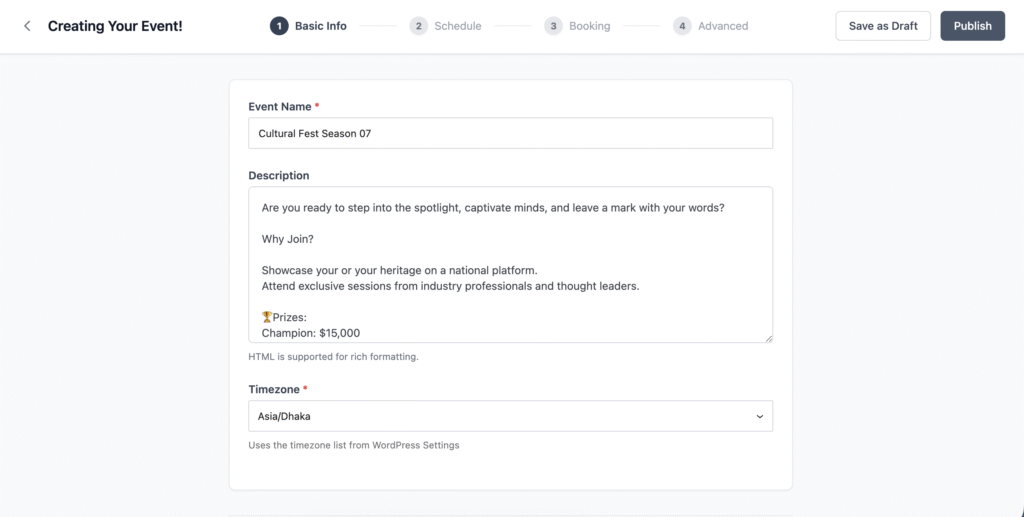
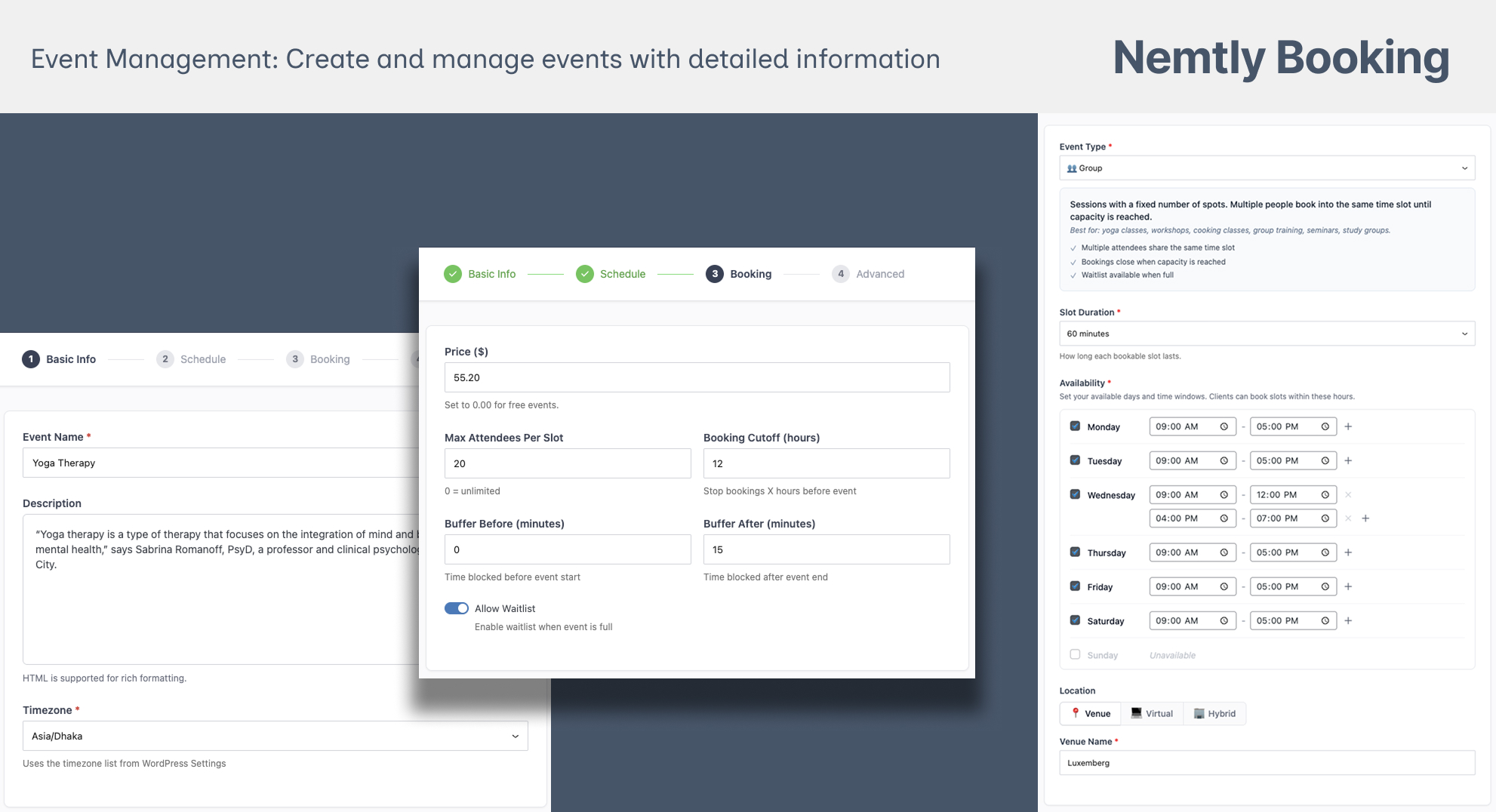
    The event creation form has four steps:

    Basic Info

    Enter a title for your event or service. For example:

    • “30-Minute Career Consultation”
    • “Saturday Morning Yoga Class”
    • “Annual Marketing Conference”

    Add a description explaining what attendees can expect. This appears on the event page your customers will see.

    Schedule

    This is where it gets interesting. First, pick your event type:

    • One-on-One — Private appointments with one attendee per slot. Best for consultations, tutoring, therapy sessions. The plugin creates individual time slots (e.g., every 30 minutes between 9 AM and 5 PM).
    • Group — Classes or workshops where multiple people attend the same slot. You set the capacity (up to 20 by default). Best for yoga classes, cooking workshops, group coaching.
    • Event — A single gathering on a specific date. Attendees pick the date, not a time slot. Best for conferences, meetups, webinars.

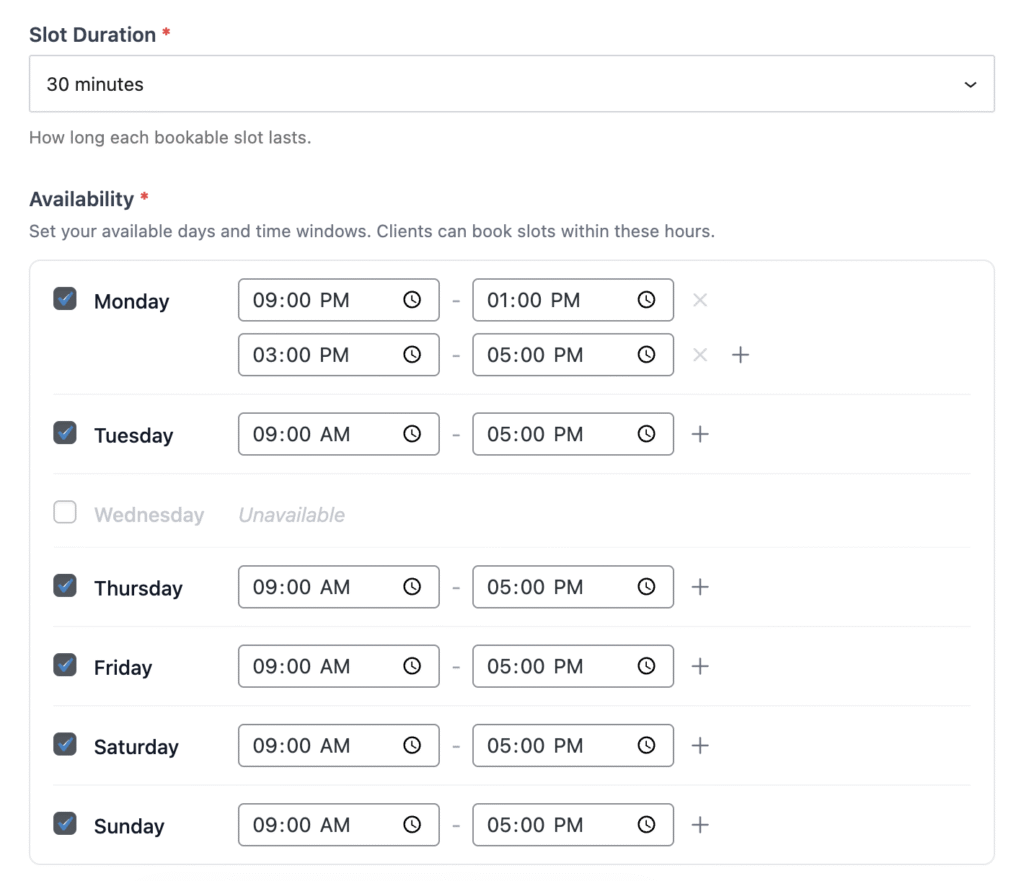
    For slot-based types (one-on-one and group), you’ll set your availability — which days of the week and what hours you’re available. The plugin generates bookable time slots automatically based on the duration you set.

    For example, if you offer 30-minute consultations and mark Tuesday and Thursday as available from 9 AM to 5 PM, the plugin creates sixteen 30-minute slots across those two days.

    You can also set:

    • Location — A physical address or a virtual meeting URL
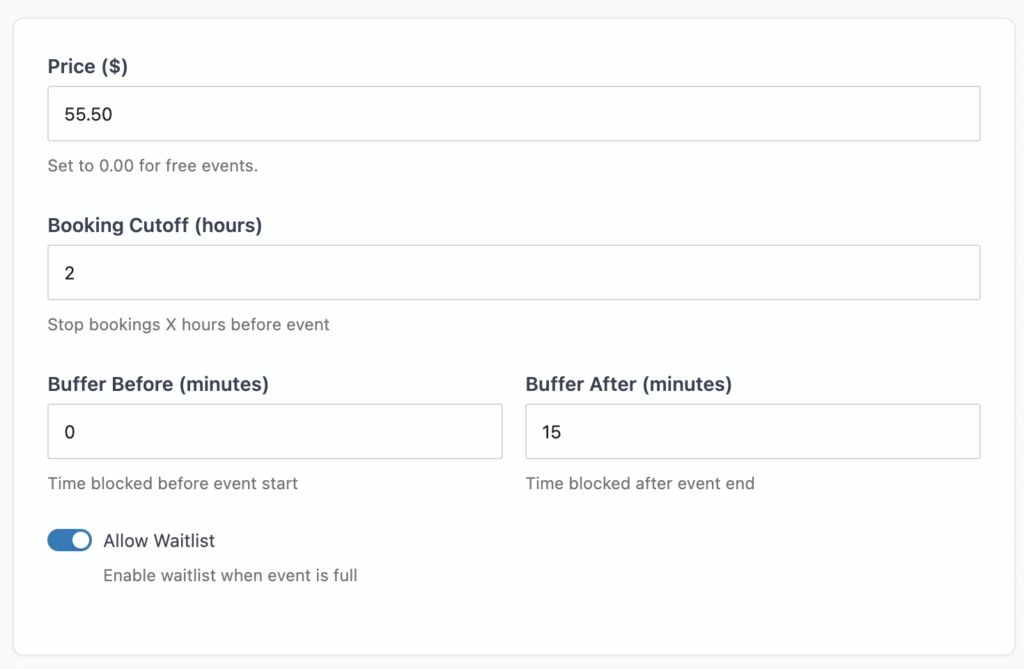
    • Buffer time — Padding before or after each appointment to prevent back-to-back scheduling

    Booking & Pricing

    Set the price for your event. Enter 0 or leave it blank for free events — the payment step will be skipped entirely for your customers.

    Configure:

    • Max attendees — How many people can book each slot (or the entire event)
    • Booking cutoff — How far in advance someone must book (e.g., 2 hours before for one-on-one, 48 hours for events)
    • Waitlist — Allow people to join a waitlist when slots fill up (available for group and event types)

    Advanced

    Optionally add a featured image that shows on event listings and the calendar.

    Click Publish when you’re ready, or Save as Draft to finish later.

    Step 3: Display Events on Your Site

    Your events need to appear somewhere your visitors can find them. Nemtly Booking gives you two ways to do this: Gutenberg blocks and shortcodes.

    Option A: Gutenberg Blocks (Block Editor)

    Open any page in the block editor and add one of these blocks:

    Event Calendar — Displays an interactive calendar where visitors can browse events by month, week, day, or list view. Visitors click an event to see details and book.

    Nemtly Events — A list/grid of your upcoming events with filters, search, and pagination. This is actually a variation of the core WordPress Query Loop block, so it works anywhere the block editor is available.

    Option B: Shortcodes (Classic Editor or Page Builders)

    If you use a classic editor or a page builder like Elementor, use shortcodes instead:

    • [nemtly_calendar] — The interactive event calendar
    • [nemtly_event_list] — A searchable, filterable event grid with pagination

    Just paste the shortcode into any page or post. Shortcodes work inside Elementor, Beaver Builder, Divi, and any other builder that supports them.

    Both options display your events with real-time availability. When a visitor clicks an event, they see available dates and times and can book directly.

    Step 4: Set Up Payments (Optional)

    If you’re charging for your events, connect Stripe so customers can pay during the booking process.

    1. Go to Nemtly Booking → Settings → Payments
    2. Enable Stripe as a payment method
    3. Enter your Stripe Publishable Key and Secret Key (find these in your Stripe Dashboard under Developers → API Keys)
    4. Enter your Webhook Secret (create a webhook endpoint in Stripe pointing to the URL shown in your settings)
    5. Save changes

    Nemtly uses Stripe’s Payment Element, which means your customers can pay with credit cards, Apple Pay, Google Pay, and other methods you’ve enabled in your Stripe account — all from a single checkout interface.

    For offline payments (cash, bank transfer, check), you can also enable manual payment recording and provide instructions that appear during checkout.

    Don’t need payments? Skip this step entirely. Free events work without any payment gateway.

    Step 5: Test the Booking Flow

    Before going live, test the experience your customers will have:

    1. Visit the page where you added your calendar or event list
    2. Click on an event
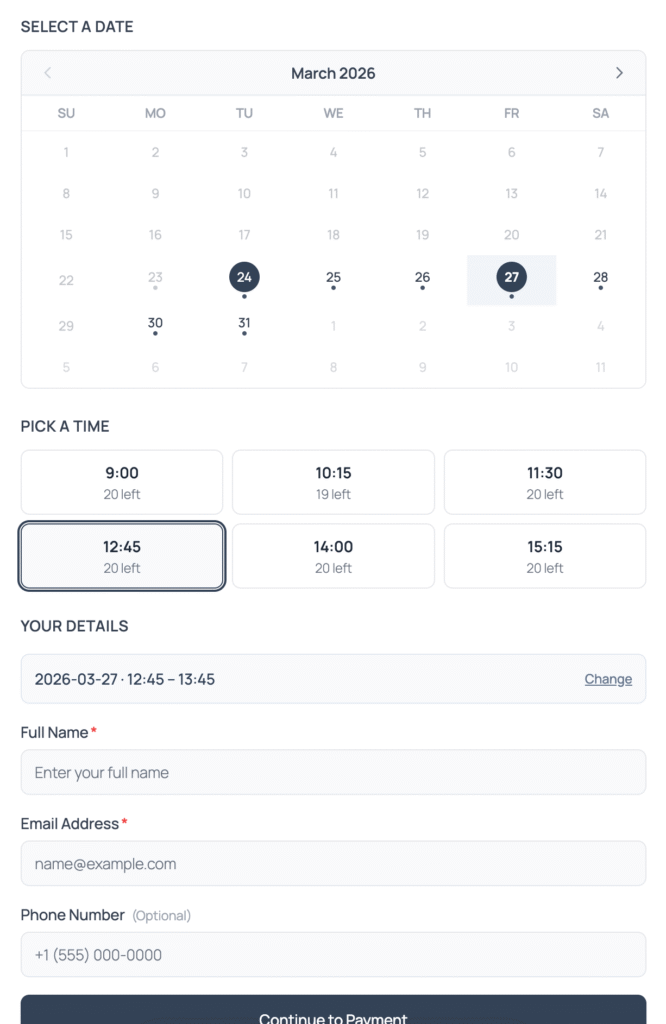
    3. Pick an available date and time slot (for slot-based events)
    4. Fill in the booking form — name, email, and optionally phone number
    5. Complete payment (if it’s a paid event) or click “Confirm Booking” (if it’s free)
    6. Check your email for the booking confirmation

    In your admin panel under Nemtly Booking → Bookings, you’ll see the new booking with its status.

    What Your Customers Experience

    Here’s the full booking flow from your customer’s perspective:

    1. Browse — They visit your page and see your events in a calendar or list
    2. Select — They click an event and pick a date and time
    3. Book — They fill in their name and email
    4. Pay — They complete payment through Stripe (or see manual payment instructions, or skip payment for free events)
    5. Confirm — They receive a confirmation email immediately
    6. Remind — They get an automated reminder email before the event (if you’ve enabled reminders in settings)
    7. Manage — They can view their bookings anytime through a customer dashboard (more on that below)

    No account creation required. No passwords to remember.

    Bonus: Set Up a Customer Dashboard

    Give your customers a place to view their booking history:

    1. Create a new page in WordPress (e.g., “My Bookings”)
    2. Add the shortcode [nemtly_booking_dashboard]
    3. Publish the page

    When customers visit this page, they enter their email address and receive a magic link — a one-time login link sent to their inbox. Clicking it logs them in for 24 hours without needing a password or WordPress account. They can see all their past and upcoming bookings.

    Bonus: Sync with Google Calendar

    If you manage your schedule in Google Calendar, Nemtly Booking can sync events both ways:

    1. Go to Nemtly Booking → Settings and connect your Google account via OAuth2
    2. Once connected, confirmed bookings automatically appear in your Google Calendar
    3. If a booking is cancelled, the Google Calendar event is removed automatically

    Set it up once and it runs in the background.

    Bonus: Email Reminders

    Reduce no-shows by sending automated reminder emails:

    1. Go to Nemtly Booking → Settings → Emails
    2. Enable Automated Reminders
    3. Set how many hours before the event the reminder should be sent (default: 24 hours)
    4. Customize the reminder subject and message

    Reminders go out automatically via WordPress cron — no manual work needed.

    Summary

    Here’s what you’ve built — in about 15 minutes and zero code:

    • A booking system with real-time availability
    • An event calendar or event list on your website
    • Online payments via Stripe (or free events without payment)
    • Automated confirmation and reminder emails
    • A customer dashboard with magic link login
    • Google Calendar sync

    All of this is free. Nemtly Booking is available on WordPress.org with no premium tier required for the features covered in this guide.

    Ready to get started? Install Nemtly Booking from WordPress.org and create your first event in minutes.